Australia’s health system is rightly respected for its clinical excellence and universal coverage. But it is also complex, fragmented, and increasingly difficult to navigate—for patients, families, and even those working within it.
As demand grows and complexity deepens the system must evolve to be more responsive, more connected, and more human. That requires more than better policy or technology. It requires a fundamental uplift in design capability, and design leadership, across the entire health system.
Learning from global health innovators
Globally, leaders like the Mayo Clinic, Cleveland Clinic, and health systems in countries like the UK and Denmark are showing what’s possible when design is embedded into healthcare innovation. These organisations, including governments, have invested not just in digital systems or service improvements, but in the capability to listen, understand, and design around real human needs. They treat design not as a workshop or a sprint, but as a strategic asset.
Australia is making promising strides in this direction, but efforts are patchy and more often than not, pilot driven. There is work to do to embed design as a strategic capability across the health system.
A fragmented system can’t be redesigned in silos
Australia’s public and private healthcare systems were designed to complement one another. But in reality, the interplay between them often leads to duplication, confusion, and gaps in care. Recent contract disputes, such as between Healthscope and major insurers, left millions of Australians at risk of losing access to preferred care or facing higher out-of-pocket costs.
This isn’t just a funding issue, it’s a human one. People needing care often find themselves caught in the crossfire of opaque systems, competing incentives, and unclear communication.
Design capability, when embedded in policy, planning and service delivery, can help untangle these complexities. It brings people together across silos, aligns around shared problems, and surfaces unmet needs early, before decisions are locked in.
Human factors are still underpowered
There’s long been recognition of the importance of patient experience, particularly in quality and safety agendas. More recently, we’re seeing efforts to support clinicians to stay connected to patients’ lived realities, not just their clinical presentations, through dedicated roles, teams, and new practices.
But these efforts are often isolated and treated as soft add-ons rather than core components of system improvement. And while listening to patients is increasingly accepted, the actual design work; generating ideas, prototyping, testing, and iterating, is still rarely embedded in the process. Further, deep, collaborative co-design where it would be appropriate remains the exception, not the norm. Without systemic design capability, these roles risk being underleveraged, their insights lost in the churn of operational pressure.
Co-Design is the goal, but we’re not yet ready
Co-design with consumers and communities is a clear priority in health policy across Australia. Government departments, health districts, and hospitals have committed to designing with, not just for, patients and communities.
But readiness to deliver on this intent is uneven. Too often, systems conflate consumer engagement with design itself. The result? Patients generously share their stories, insights, and experiences… only for services to jump straight to piloting pre-determined solutions without the governance, structures, or space needed to support true design practice.
Design capability builds the skills and structures to go beyond consultation towards deep co-design, problem definition, and iterative, evidence-led change.
From research to real change
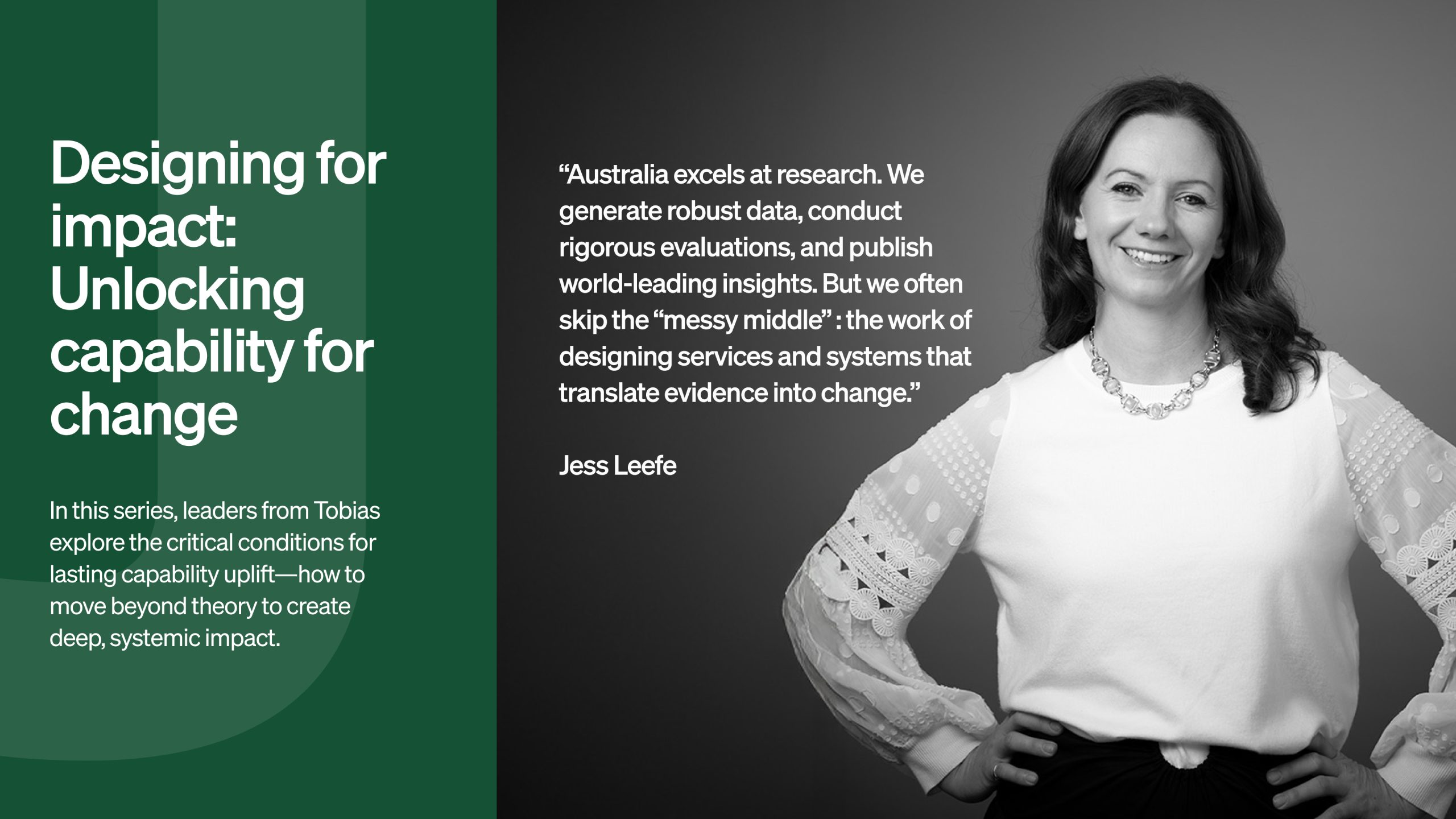
Australia excels at research. We generate robust data, conduct rigorous evaluations, and publish world-leading insights. But we often skip the “messy middle”: the work of designing services and systems that translate evidence into change.
That middle ground, where deep needs are turned into ideas, tested in practice, refined with feedback, and scaled through lived experience, is where the future of healthcare improvement lies.
The future is designed
If we want a healthcare system that is not just clinically safe but also intuitive, coordinated, and compassionate, we need to build the muscle of design across the sector.
That means:
- Investing in design capability, not just design thinking workshops
- Supporting shared services and clinical leaders to co-design meaningfully
- Embedding design governance alongside clinical and financial governance
- Backing design leadership to hold space for learning, iteration, and creativity
- Recognising that meaningful change requires more than listening or large committees, it demands system-wide design capability across skills, processes, governance, and culture
Healthcare is about people. It always has been. And people-centred systems don’t happen by accident. They happen by design.