
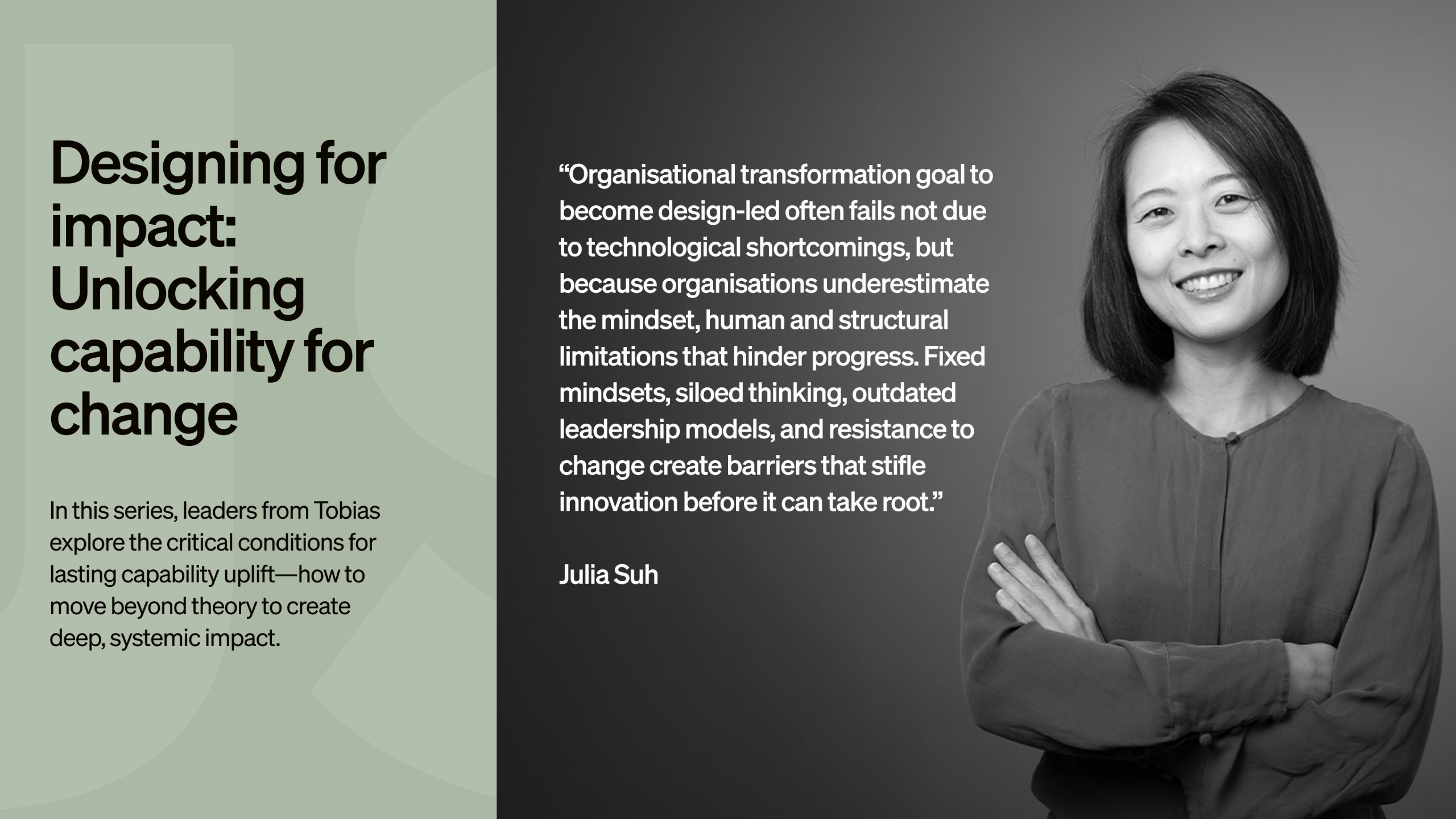
Organisational transformation goals to become design-led often fails not due to technological shortcomings, but because organisations underestimate the mindset, human and structural limitations that hinder progress. Fixed mindsets, siloed thinking, outdated leadership models, and resistance to change create barriers that stifle innovation before it can take root.
Simply inserting the Double Diamond framework into design processes doesn’t work without fostering a deep internal understanding of its purpose, intent and practical application in parallel. Exemplary frameworks risk being superficial rather than transformative without the enabling conditions.
Understanding the Barriers to Change
Organisations frequently face three core limitations:
- Mindset Limitations – Individualistic behaviours, resistance to collaboration, and a fixed perspective, at times in an attempt to manage own expectations and work
- Human Limitations – Bounded rationality (derived from operating within cognitive biases, incomplete information, and time pressures etc.) and a tendency to settle for “good enough” or comfortable decisions
- Structural Limitations – Outdated leadership models that prioritise hierarchy, control, and rigid processes; complex systems, siloed teams, rigid budget constraints, and change inertia
Removing the Limitations
True transformation requires investment not just in skills and tools, but in people and processes that enable innovation to take root. Part of this process is removing the limitations. This means considering the following holistically:
- Training & Investment – Upskilling employees through Human-Centered Design (HCD) programs and foundational learning in design methodologies.
- Collaboration & Partnership – Engaging cross-functional teams, partnering with experienced designers for hands-on learning and mindset shift, and fostering mentorship.
- Data & Insights – Aligning on the desired uplift outcomes and setting up athe measurement framework that can assess the change effectively.
- Leadership Commitment – Embedding new ways of working into organisational strategies and governance models to sustain innovation.
Building a Future-Ready Workforce
At Tobias, we have seen success when we embedded capability consistently and progressively, building the organisational buy-in alongside internal ability to adapt, evolve, and empower people to lead change, and safeguarding transformation from dissolution due to leadership changes. We have codified our process that supports its sustainability and success.
- Leadership sponsorship for design – Initial endorsement of design-led approach
- Hypotheses for design impact – Align views on the benefits and expectations
- Testing and validation – Implementation of a formalised, human-centred, iterative design approach
- Codification and documentation – Development of a structured and repeatable framework for human-centred approach
- In practice – Adoption of the new approach, led by trained internal team committed to embedding human-centred methodologies
- Scaling beyond the early adoption – Expansion of human-centred design training to additional teams, amplifying design impact across the organisation.
Organisational transformation won’t be a change seen overnight. Rather it’s a series of small changes in your colleagues’ behaviours, skills, ways of working, and seeing them gradually stepping into the role of championing structural change.

