‘Modernising My Health Record Sharing by Default Bill 2024’ benefits realisation framework
Department of Health and Aged Care
Strategic Insight And Foresight, Future Ways Of Working, Human Centred Digital Transformation, Better Government, Connected Health

The Digital Health Branch of the Department of Health and Aged Care (DoHAC) commissioned Tobias to analyse the potential benefits, disbenefits and risks of the Share by Default initiative. The project used a human-centered approach, engaging key stakeholders to create a Benefits & Risks Map and a Benefits Modelling Tool to inform Policy Impact Analysis. These tools provided transparent, evidence-based insights into the initiative’s potential, supporting scenario testing and ongoing evaluation. The project also contributed to legislative changes and strengthened DoHAC’s organisational capability in evidence-based decision-making, with sustainable tools for future projects.
Identifying and analysing potential benefits and disbenefits to inform Policy Impact Analysis
The Department of Health and Aged Care’s Digital Health Branch was tasked with gathering evidence associated with changes being made to My Health Record (MHR), known as Share by Default, which would mandate healthcare providers to share health information to the My Health Record system. Tobias was commissioned to identify and analyse potential benefits and disbenefits for My Health Record Share by Default to inform Policy Impact Analysis, and uplift the DoHAC team’s capability leveraging the project process and outputs.
Supporting scenario testing and continuous evaluation
To understand the impact of the change, Tobias took a human-centred approach to identifying and evaluating potential benefits and disbenefits for the key stakeholders: consumers, healthcare providers, pathology and diagnostic imaging providers and healthcare systems / administrators and government. To ensure our outputs are used effectively beyond their initial use, they were designed with the goal to support scenario testing and continuous evaluation of the change.
Consolidated Benefits & Risks Map
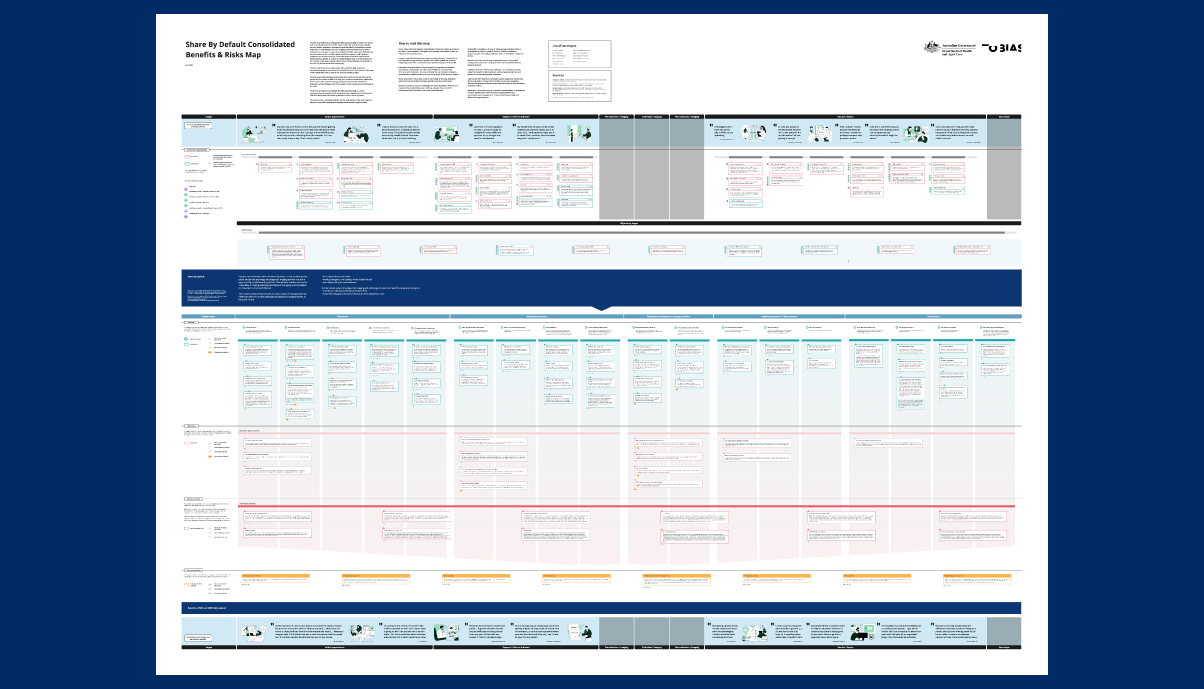
The Share By Default Consolidated Benefits and Risks Map is a visual representation of consolidated findings that relate specifically to the benefits and risks associated with Share by Default. The Map provided an in-depth view of the impact Share By Default would potentially have on people, processes, systems and policies within the healthcare sector. It was created based on a consolidation of data, insights and information from Tobias’s primary research and secondary research including findings from an environmental scan of other global healthcare systems and initiatives completed. The map creation involved a number of internal and external stakeholder engagement activities to fill knowledge gaps and build a shared understanding between the stakeholder groups.
The Share By Default Consolidated Benefits and Risks Map begins by demonstrating the current state of My Health Record in the top half of the map. Then the Share By Default initiative transitions the map from current state to the potential future state of MHR. The map then explores the benefits, disbenefits, barriers and risks, and the enabling conditions required for full benefit realisation of the initiative. The future state is then presented at the bottom of the map as described by clinician cohort research participants.
Benefits register and economic modelling
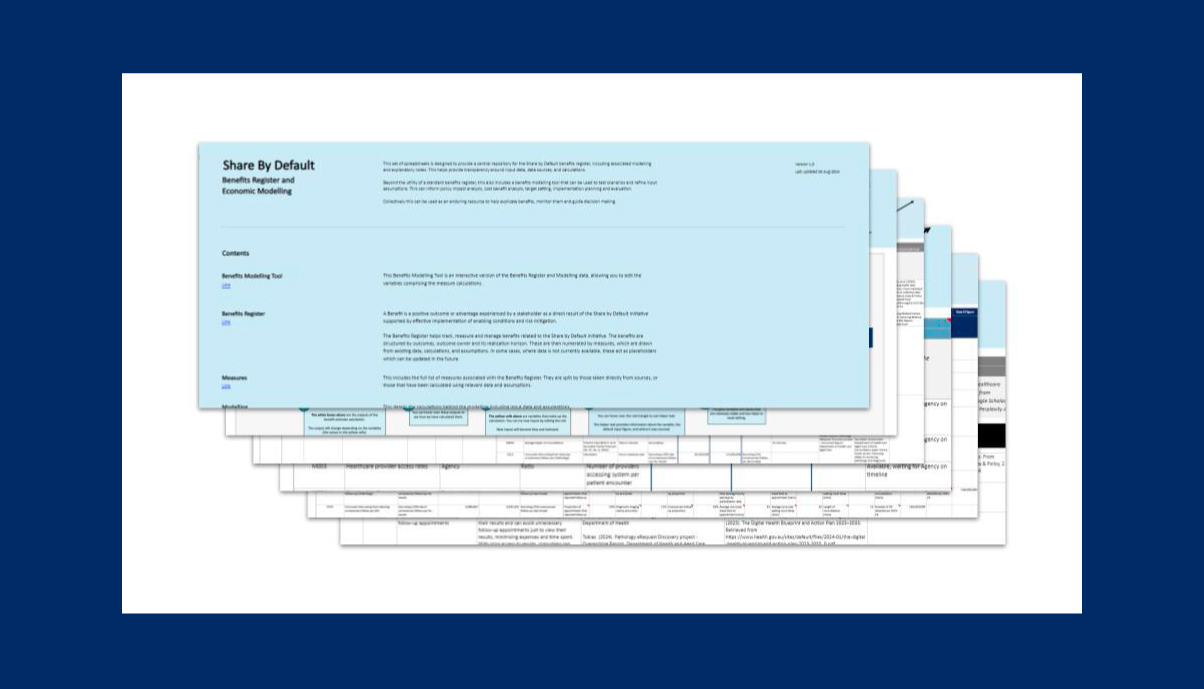
A set of spreadsheets was designed to provide a central repository for the Share by Default benefits register, including associated modelling and explanatory notes. This method helped provide transparency around input data, data sources, and calculations. Beyond the utility of a standard benefits register, this also included a benefits modelling tool that could be used to test scenarios and refine input assumptions. The tool can be used to inform policy impact analysis, cost benefit analysis, target setting, implementation planning and evaluation. Collectively the set was designed to be used as an enduring resource to help explicate benefits, monitor them and guide decision making.
- This Benefits Modelling Tool, an interactive version of the Benefits Register and Modelling data, allowed editing of the variables comprising the measure calculations.
- The Benefits Register helped track, measure and manage benefits related to the Share by Default initiative. The benefits were structured by outcomes, outcome owner and its realisation horizon. These were then numerated by measures, which were drawn from existing data, calculations, and assumptions. In some cases, where data was not currently available, these acted as placeholders which can be updated in the future.
- Measures included the full list of measures associated with the Benefits Register. They were split by those taken directly from sources, or those that have been calculated using relevant data and assumptions.
- Modelling detailed the calculations behind the modelling including input data and assumptions.
- Resources provided a comprehensive collection of documentation and data sources associated with the benefits, disbenefits, risks, and enabling conditions detailed in the Share By Default Consolidated Benefits & Risks Map.
Capability building
Transforming the way we work is as much about mindset as it is about tools, techniques and technology. Digital transformation is about delivering improvements to policy, process and technology to better meet user needs. It uses evidence-based decision-making, improves the experiences of people using both front- and back-end systems. It’s a new way of working that encourages organisations to constantly improve and adapt. Through digital transformation, organisations reform how they operate and how they deliver value to their users. Focus is placed on designing and building the right solution. What is critical about this is the focus is far from just about digital, data or technology. Rather on mindsets, ways of working, and consideration of user needs. This is the philosophy upon which the capability uplift work was delivered.
To commence transformative learning, just-in-time learning methods were used to deliver three sessions directly related to the project outputs. This created a sustainable approach & tools for collection, analysis and ongoing evaluation of programs.
Changes being made to legislation (“Act” as of May 2025)
Through engagement with key stakeholders and a thorough review of existing models and frameworks, the project identified key drivers of value across the ecosystem and provided insights into how to effectively demonstrate benefits for all stakeholders. The project developed a deeper understanding of the factors influencing human and organisational behaviours and enablers that would contribute to benefits realisation. Additionally, the implementation of a whole-of-government evaluation approach within the Digital Health Branch ensured the sustainable and ongoing use of the developed models, tools, and skills. This approach has since been applied to additional projects involving broader teams. Ultimately the project contributed to the delivery of DoHAC’s Impact Analysis (IA) and building evidence for legislative change.