
The Government needs to build Strategic Design Capability to address the increasingly complex nature of society’s challenges — but do leaders have the skills to make it stick?
As governments grapple with increasingly complex challenges, from climate adaptation to digital inclusion, the need for more effective, sustainable, human-centred solutions is more urgent than ever.
Human-Centred Design is Critical to Digital Transformation Success
Too many technology projects fail – not because the technology is flawed, but because they solve the wrong problem, for the wrong people, in the wrong way.
In a rush to deliver, organisations often jump straight to building solutions, committing millions in development before truly understanding what users need, or whether the solution will work in the real world.
The often cited Mckinsey report states that…
- 70% of digital transformations fail to meet expectations.
- Poor user adoption is one of the top three reasons IT projects underperform.
- Rework costs increase by 10x or more once you’re in development or post-launch.
Human-centred design is an approach to reduce this risk.
Instead of guessing, test early, cheaply, and often, with real users. Spend time understanding the problem before designing the solution. Co-design, prototype, and validate before we build. Test, learn and test again.
This means you reduce risk, increase certainty, and build things that actually get used – because they’re built with the people who will use them.
Strategic design capability embeds the human-centred tools, mindsets, and practices to meet these challenges, but investing in design alone isn’t enough. For design capability to stick, grow, and evolve over time, we’ve seen from experience that leadership plays a pivotal role in shaping the conditions for success.
Design capability isn’t just about adopting new tools or running a few user interviews. It’s about embedding a new way of thinking and working, one that prioritises empathy, cross disciplinary collaboration, experimentation, and systems thinking. This shift requires more than a surface-level commitment; it demands cultural transformation. And culture is a reflection of the top, what they care about and what they reward.
At Tobias, as a Strategic Design Consultancy, we’ve partnered with public sector teams across jurisdictions. Time and again, we’ve observed that the most successful outcomes emerge when leaders intentionally cultivate an environment that supports psychological safety and creativity. These two ingredients are essential – not just for effective collaboration, but for the kind of deep learning and skill-building that embeds design into the DNA of an organisation. Of course leaders also need a good understanding of human-centred design, its methods and benefits, so they can support the planning, budgeting and evaluating of programs to succeed with design built in every step of the way.
Psychological Safety: The Foundation of Capability Building
In environments where psychological safety is lacking, people are less likely to take risks, ask questions, or challenge the status quo, all of which are essential to good design. When government teams feel safe to explore, test, and even fail, they begin to unlock new ways of seeing and solving problems. This doesn’t happen by accident. Leaders must actively model openness, celebrate learning, and provide space for reflection. They must protect this space, even when the pressure to deliver is high. Environments where leaders fail to acknowledge their own shortcomings and don’t provide space for others to be heard hinder learning and growth.
Creativity Needs Cultivation
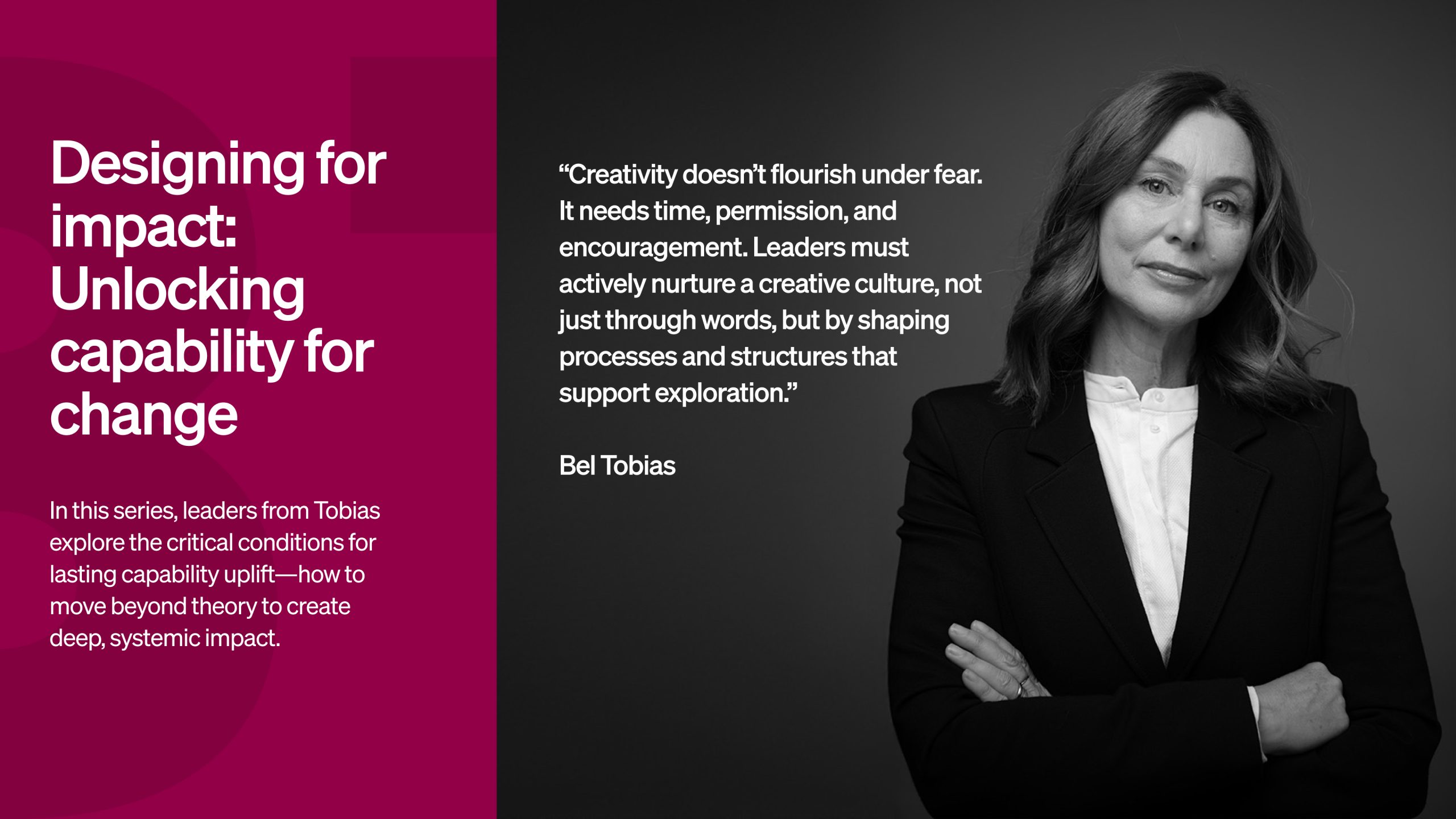
Creativity doesn’t flourish under fear. It needs time, permission, and encouragement. Leaders must actively nurture a creative culture, not just through words, but by shaping processes and structures that support exploration. That might mean redesigning workflows to allow for prototyping, providing training that stretches the imagination, or simply giving teams the time and autonomy to try new things.
Developing an organisation’s capabilities is an ongoing process, not a singular event. It’s a long-term investment in growing the muscles, bones, and memory of an organisation, a full-body transformation. It’s about shifting not only what people do but how they think. And just like with physical fitness, growth takes discipline, repetition, and coaching. Learning alongside others who have done it many times before.
The Role of Leadership: From Sponsor to Cultivator
Leaders in government often see themselves as sponsors of design work – allocating budget, championing projects, or signing off deliverables. But to truly build capability, they must step into a more active role as cultivators of culture. This means anticipating resistance, preparing their teams for change, and creating the enabling conditions for design to take root.
From our experience, the difference between a team that thrives and one that stalls comes down to the intentionality with which leadership approaches capability. Leaders must set the tone, embody the mindset, and consistently reinforce the value of design – not just in words, but in action. That includes celebrating learning over perfection, welcoming diverse perspectives, and staying curious in the face of ambiguity.
Sustaining Capability Over Time
Real transformation sticks when design becomes embedded in how things are done – not just in isolated teams, but across policy, operations, and service delivery. This requires more than short-term wins; it requires strategic investment in skills, mindsets, governance and structures that can adapt and evolve. It’s not just about building a toolkit, it’s about building a culture to support the capability.
At Tobias, we’re passionate about helping government leaders make this shift. Because when public institutions build lasting design capability, they become more resilient, more responsive, and ultimately, more effective. Get in touch to learn more about our APS capability uplift program.

